


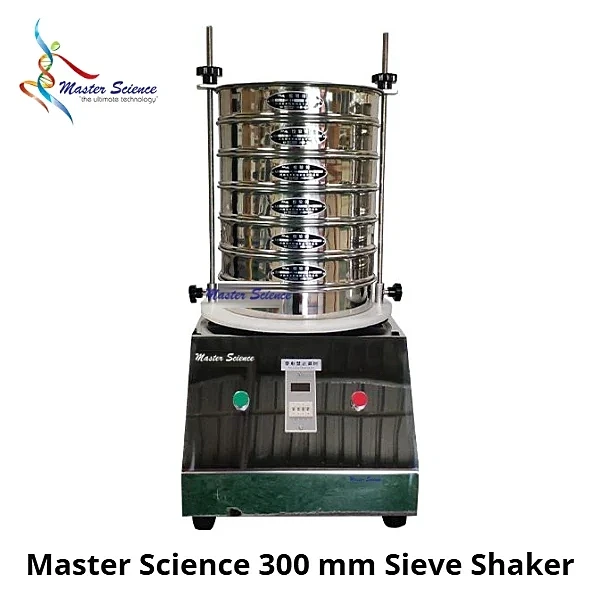
Test Sieve Shaker - Vibratory Laboratory Sieve Shaker - 300 mm - 8 Sieves
Inhouse product


The Master Science 300 mm Sieve Shaker takes test sieves up to 300 mm in diameter, giving a larger sieving area for bigger samples of aggregates, minerals, powders and granules. A 0.18 kW vibration motor moves the stack so each fraction collects on its own sieve.
The machine stands on the bench without bolting, runs quietly and stops automatically when the set time ends.
Technical Specifications
Technical details of the Master Science 300 mm Sieve Shaker:
- Brand: Master Science
- Model Number: MSTS-300SWISS
- SKU: MSTS-300SWISS
- Brand: Master Science
- Model Number: MSTS-300SWISS
- SKU: MSTS-300SWISS
- Sieve Diameter: Up to Ø300 mm
- Sieve Mesh Range: 0.025 to 50 mm
- Sieve Capacity: Up to 8 layers including bottom pan
- Motor Power: 0.18 kW
- Vibration Amplitude: 0 to 3 mm
- Vibration Frequency: 1440 per minute
- Noise: < 50 dB
- Timer: Timed automatic shutdown
- Power Supply: 220 V, 50 Hz
- External Dimensions (L × W × H): 470 × 430 × (370 + N × 60) mm, N = number of sieves
- Net / Gross Weight: 40 kg / 45 kg
- Package Dimensions: 540 × 480 × 450 mm
Key Benefits
- Bigger sample per test: the Master Science 300 mm Sieve Shaker accepts 300 mm sieves.
- Up to 7 fractions at once: stack of 8 sieves.
- Hands-free runs: timed automatic stop.
- Comfortable to work beside: noise below 50 dB.
- Flexible mesh choice: sieves selected to suit the material.
For 200 mm sieves, see the Master Science laboratory sieve shaker.
Product Features
Sieving
- Sieves up to Ø300 mm
- Mesh 0.025 to 50 mm
- Up to 8 layers
Drive
- 0.18 kW vibration motor
- 0 to 3 mm amplitude
- 1440 vibrations per minute
Use
- Timer shut-off
- Free-standing bench design
- Low noise
Applications
The Master Science 300 mm Sieve Shaker is used for:
- Construction aggregate grading
- Mineral and ore analysis
- Food powders and grains
- Chemical, pigment and abrasive QC
- Ceramics and metallurgy labs
Optional Accessories
- Test sieves Ø300 mm in selected mesh sizes
Common Laboratory Problems and How This Shaker Helps
How the Master Science 300 mm Sieve Shaker helps with sieve testing:
- Small sieves overload with coarse samples: 300 mm sieves spread the load.
- Operator-dependent results: fixed vibration and timer.
- Unattended tests running too long: automatic stop.
- Bolting machines to benches: free-standing design.
Frequently Bought Products
"Explore Master Science, your trusted provider of high-quality laboratory equipment and innovative solutions. Discover our extensive range of analytical instruments and exceptional customer support, all dedicated to empowering scientific discovery across industries. Join us in advancing research and setting new standards globally."


