


Portable Colorimeter - D/8 Color Spectrophotometer - 400-700 nm - ΔE 0.04 Repeatability
Inhouse product
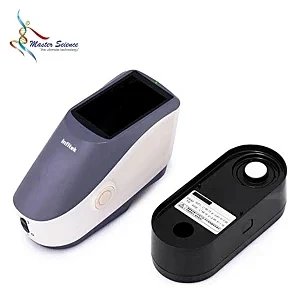
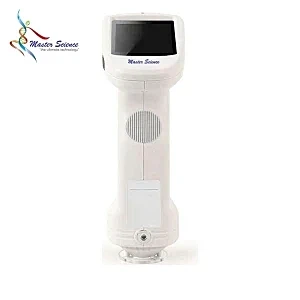


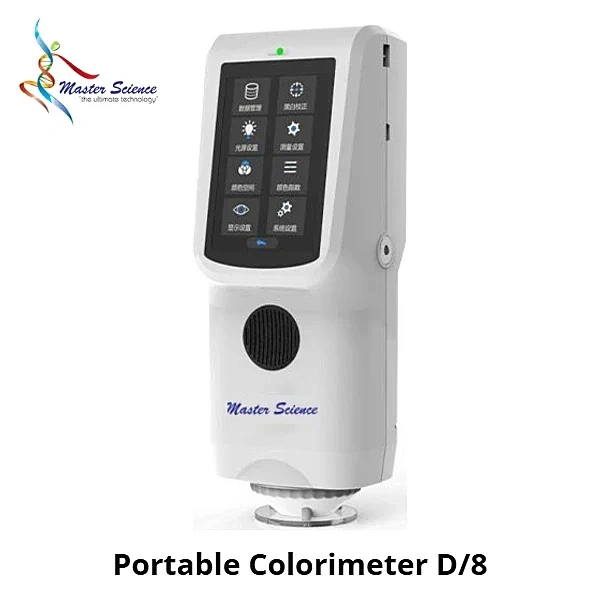
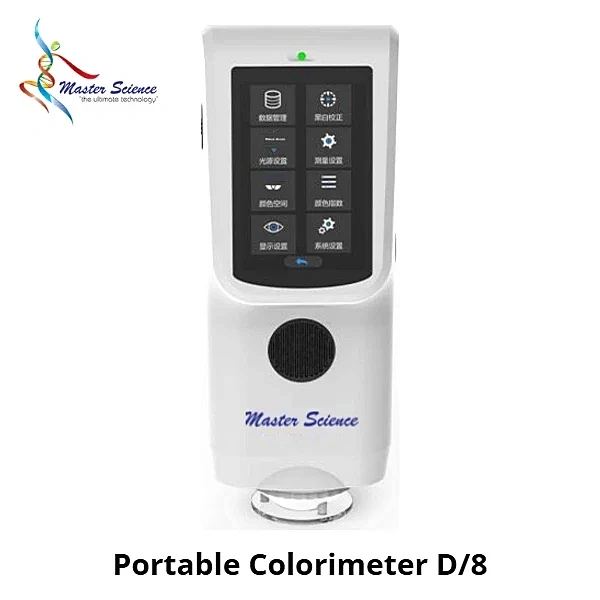
The Master Science Portable Colorimeter is a handheld grating spectrophotometer for measuring color and color difference on plastics, paints, inks, textiles, printed materials and ceramics. A full-band balanced LED source and dual 32-element silicon photodiode arrays measure reflectance from 400 to 700 nm in about 1.5 seconds.
With D/8 geometry, SCI mode and a repeatability of ΔE*ab 0.04, the instrument delivers consistent readings on the production line, in the QC lab and between several units at different sites.
Technical Specifications
Detailed specifications of the Master Science Portable Colorimeter:
- Brand: Master Science
- Model Number: MSSP-CLR8SWISS
- SKU: MSSP-CLR8SWISS
- Optical Geometry: D/8 (diffuse illumination, 8° viewing), SCI
- Standards: CIE No.15, GB/T 3978, GB 2893, GB/T 18833, ISO 7724-1, ASTM E1164, DIN 5033 Part 7
- Integrating Sphere: Ø40 mm
- Light Source: Full-spectrum combined LED
- Spectral Method: Planar grating
- Sensor: Silicon photodiode arrays, dual row of 32
- Wavelength Range: 400 to 700 nm
- Wavelength Interval: 10 nm
- Half Bandwidth: 10 nm
- Measurement Range: L* 0 to 120; reflectance at 3 user-defined wavelengths (default 440, 550, 600 nm)
- Measuring Aperture: Ø8 mm (Ø4 mm optional)
- Color Spaces: CIE LAB, XYZ, Yxy, LCh
- Color Difference Formulas: ΔE*ab, ΔE*00
- Observer: 10°
- Illuminants: D65, A, F2 (CWF)
- Display Resolution: 0.01
- Measurement Time: About 1.5 s
- Repeatability: ΔE*ab within 0.04 (white tile, 30 readings at 5 s intervals)
- Inter-instrument Agreement: ΔE*ab within 0.35 (average of 12 BCRA Series II tiles)
- Measurement Modes: Single or average of 2 to 99 readings
- Battery: Lithium, about 6000 measurements in 8 hours
- Lamp Life: 5 years, more than 3 million measurements
- Display: 3.5-inch TFT capacitive touchscreen
- Data Ports: USB, Bluetooth 5.0
- Data Storage: 500 standards, 10,000 samples
- Operating Conditions: 0 to 40 °C, 0 to 85 % RH non-condensing, altitude below 2000 m
- Dimensions (L × W × H): 81 × 71 × 214 mm
- Weight: About 460 g
Key Benefits
- Consistent data across sites: tight inter-instrument agreement lets several Master Science Portable Colorimeter units share the same color standards.
- Accurate color in every band: the balanced LED source fills spectral gaps found in white LEDs.
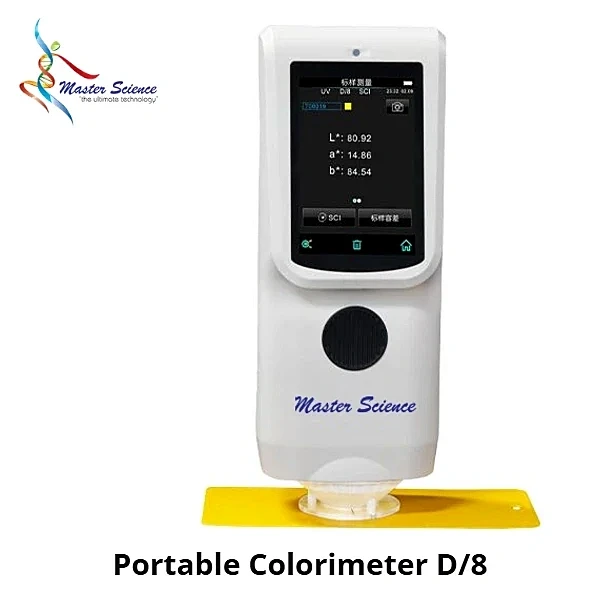
- Fast pass/fail decisions: color difference, offset and pass/fail results appear immediately on the touchscreen.
- All-day field use: one charge covers about 6000 measurements.
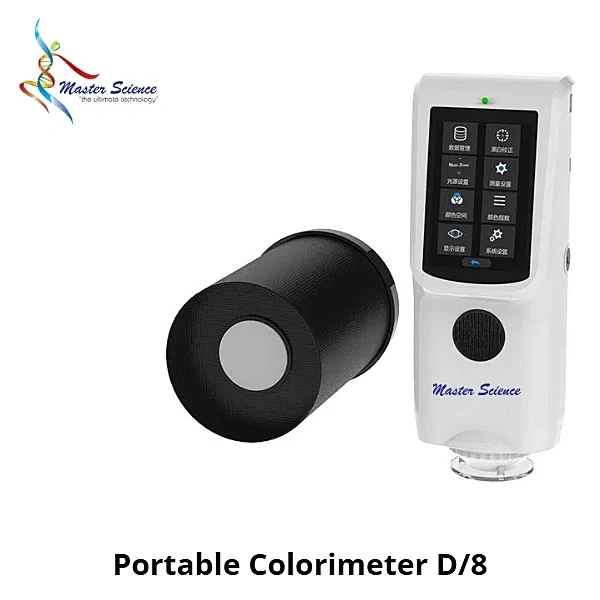
- Clean calibration: a protective base keeps the white tile free of dust and marks.
Optical labs measuring liquids rather than surfaces can use the Master Science UV-Vis spectrophotometer.
Product Features
Optics
- Full-band balanced LED illumination
- Planar grating spectral separation
- Dual 32-element silicon photodiode arrays
- Ø40 mm integrating sphere
Measurement and Display
- Reflectance at three user-selected wavelengths
- Chromaticity, color difference value and graph
- Pass/fail, color simulation and color offset views
- 3.5-inch capacitive touchscreen
Design
- Ergonomic grip and measurement button
- Ø8 mm aperture with Ø4 mm option
- Fast charging with low-battery reminder
- USB and Bluetooth 5.0 connectivity
Applications
The Master Science Portable Colorimeter is used for color control in:
- Plastics and electronic housings
- Paints, coatings and inks
- Textile dyeing, printing and garments
- Printing and packaging
- Ceramics and building materials
Standard Accessories Included
- Power adapter
- Data cable
- User manual
- Black and white calibration box
- Protective cover
- Wrist strap
- Ø8 mm platform aperture
Optional Accessories
- Ø4 mm platform aperture
- USB micro printer
- Bluetooth micro printer
- Powder test box
- Holder base
Common Color Control Problems and How This Colorimeter Helps
How the Master Science Portable Colorimeter helps with typical color quality issues:
- Visual color judgement differs between inspectors: objective ΔE values replace subjective checks.
- Different results from different instruments: low inter-instrument error keeps data consistent.
- Slow inspection on the line: each reading takes about 1.5 seconds.
- Small or curved samples: the 4 mm aperture option fits small areas.
- Manual data transfer: USB and Bluetooth send results to a PC or printer.
Frequently Bought Products
"Explore Master Science, your trusted provider of high-quality laboratory equipment and innovative solutions. Discover our extensive range of analytical instruments and exceptional customer support, all dedicated to empowering scientific discovery across industries. Join us in advancing research and setting new standards globally."


